Friday, July 26, 2013

Company Culture


Netflix posted an amazing deck on their Company Culture.
Netflix Culture: Freedom and Responsibility

The following points really hit home for me, so I wanted to share them with you.

Judgement

  • You make wise decisions (people, technical, business, and creative) despite ambiguity
  • You identify root causes, and get beyond treating symptoms
  • You think strategically, and can articulate what you are, and are not, trying to do
  • You smartly separate what must be done well now, and what can be improved later

Communication

  • You listen well, instead of reacting fast, so you can better understand
  • You are concise and articulate in speech and writing
  • You treat people with respect independent of their status or disagreement with you
  • You maintain calm poise in stressful situations

Impact

  • You accomplish amazing amounts of important work
  • You demonstrate consistently strong performances so colleagues can rely upon you
  • You focus on great results rather than on process
  • You exhibit bias-to-action, and avoid analysis-paralysis

Curiosity

  • You lean rapidly and eagerly
  • You seek to understand our strategy, market, customers, and suppliers
  • You are broadly knowledgeable about business, technology and entertainment
  • You contribute effectively outside of your specialty

Innovation

  • You re-conceptualize issues to discover practical solutions to hard problems
  • You challenge prevailing assumption when warranted, and suggest better approaches
  • You create new ideas that prove useful
  • You keep us nimble by minimizing complexity and finding time to simplify

Courage

  • You say what you think even if it is controversial
  • You make tough decisions without agonizing
  • You take smart risks
  • You question actions inconsistent with our values

Passion

  • You inspire other with your thirst for excellence
  • You care intensely about success
  • You celebrate wins
  • You are tenacious

Honesty

  • You are known for candor and directness
  • You are non-political when you disagree with others
  • You only say things about fellow employees you will say to their face
  • You are quick to admit mistakes

Selflessness

  • You seek what is best for , rather than best for yourself or your group
  • You are ego-less when searching for the best ideas
  • You make time to help colleagues
  • You share information openly and proactively

If all companies followed these values, just think of the potential. 

Sunday, July 14, 2013

Building Confidence

I just started reading Lean In: Women, Work, and the Will to Lead by Sheryl Sandberg. I figured reading about the journey of a successful female in the IT industry would help provide insight on how to further my development.

I'm only about 25% the way through (according to my Kindle), but she brings up some interesting points, one of which I wanted to mention.

She quotes a 2011 McKinsey report which found "men are promoted based on potential, while women are promoted based on past accomplishments."
She goes on to say:
"In addtion to the external barriers erected by society, women are hindered by barriers that exist within ourselves. We hold ourselves back in ways both big and small, by lacking self-confidence, by not raising our hands, and by pulling back when we should be leaning in. We internalize the negative messages we get throughout our lives - the messages that say it's wrong to be outspoken, aggressive, more powerful than men."

I sub-consciously already knew this, but seeing it written on paper really drives home the internal barriers preventing me from seeing what my co-workers already see in me. 
My boss saw something in me that caused him to jump at the chance to bring me on to his team. For the first few months, it was a bit surreal for me, I know I probably drove him crazy constantly thanking him for the opportunity. I kept thinking how lucky I was to move into a role that I didn't even know existed a year before. 
6 months into it, I've grown wiser and understanding that it wasn't luck that gave me this opportunity, but my own talent and accomplishments. Building confidence in my abilities is the first step in my journey to becoming a 'Rockstar' Product Manager.

-Jenn

Wednesday, July 03, 2013

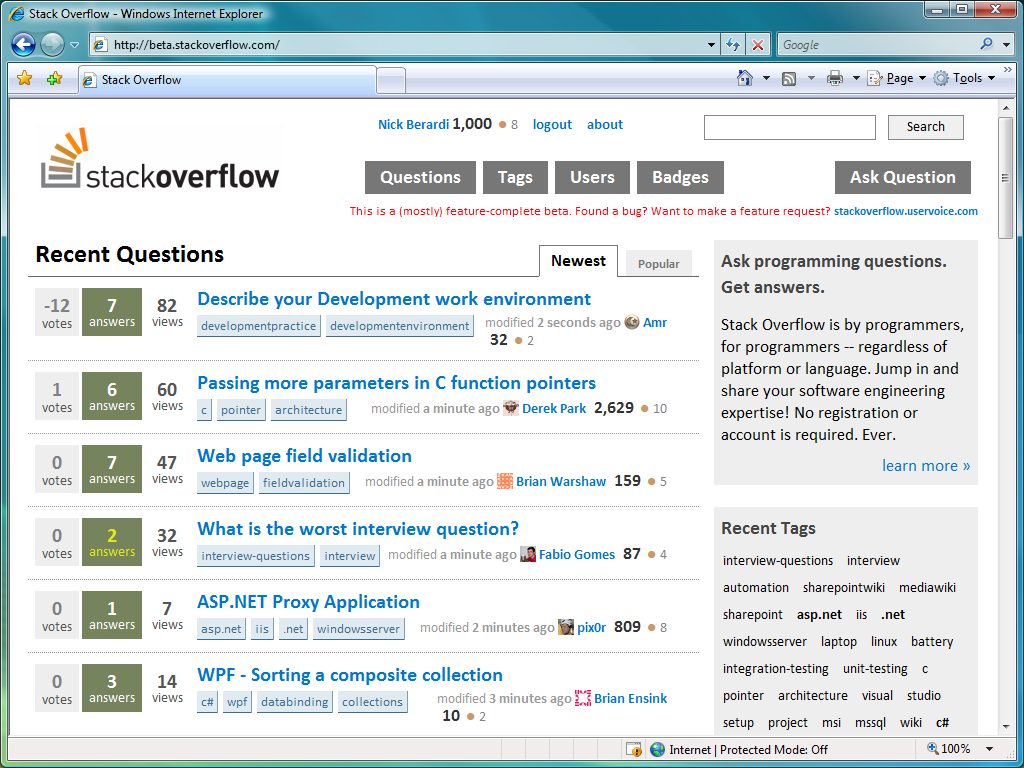
Formats for a Technical User Community - Feeds vs Forums

The question of the moment is, for a Technical User Community, what type of format do users prefer?

A Feed - example: SalesForce Chatter
Simple posts and short attention span of Users, cause they're on to the next post.


A Forum - example: StackOverflow.com.
Questions and Discussions with a traditional Forum format. Categorizing posts and allowing additional formatting.


The feed format is definitely the new hip look, great for collaboration, but does it play to the geek in a technical user? Sometimes we just want a simple easy format we're use to when searching for answers.

Can you include all the necessary information needed to troubleshoot a issue within a Feed Thread?

We'll have to see what develops.